

The same measurement principles serve a grain elevator and a pharmaceutical lab. How Michelli supports agriculture, food, pharma, logistics, and manufacturing with one partnership.
A grain elevator weighing a truckload of corn and a pharmaceutical lab weighing a few milligrams of active ingredient look like completely different problems. The equipment is different, the tolerances differ by orders of magnitude, and the regulations answer to different agencies.
The underlying requirement is identical. Both need a device that reads correctly, proof that it does, and someone who can fix it when it does not.
That is why one measurement partner can serve both — and why splitting that work across vendors by industry usually creates more problems than it solves.
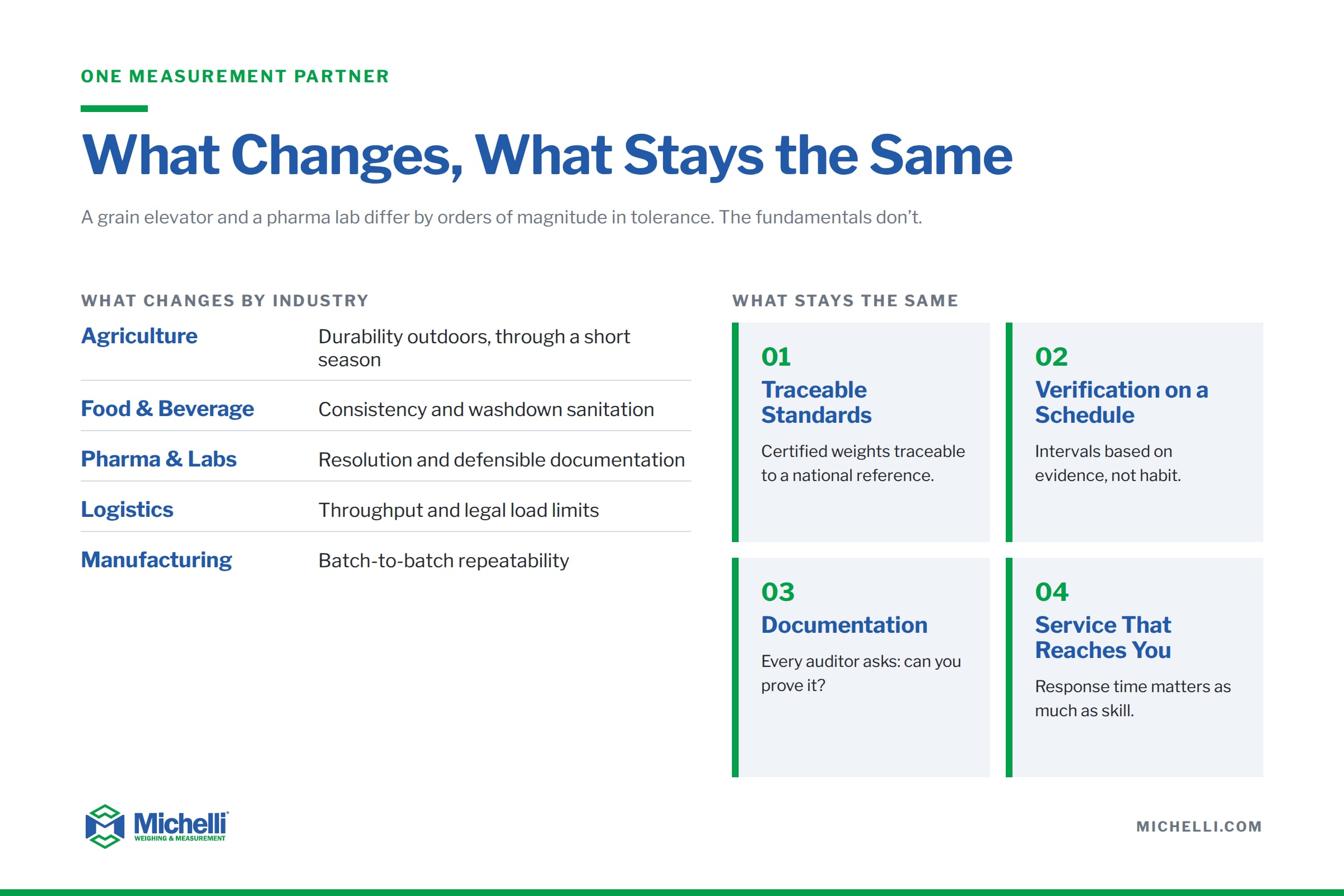
What Changes Between Industries
Each sector puts its own pressure on measurement.
Agriculture demands durability. Equipment lives outdoors, works hardest during a short season, and settles transactions where a drifting scale moves real money on every load. See our agriculture spotlight for how this plays out.
Food and beverage demands consistency and sanitation. Portion control drives both cost and customer trust, and equipment must survive frequent washdown. We covered this in How Precision Weighing Optimizes the Food & Beverage Industry.
Pharmaceuticals and laboratories demand resolution and documentation. Small variations change outcomes, and every measurement must be defensible on inspection — as covered in Fueling Scientific Advancement.
Logistics and transportation demand throughput and legal compliance. Overweight shipments draw fines; underloaded trailers waste capacity. Accuracy is directly tied to margin — see transportation and logistics.
Manufacturing demands repeatability. Batch-to-batch consistency depends on instruments that read the same today as at the last verification. The same is true in waste and recycling, aerospace, and energy, each with its own tolerance and documentation regime.
What Stays the Same
Underneath those differences, the same four things determine whether measurement can be trusted anywhere.
Traceable Standards
Whether the device is a truck scale or an analytical balance, calibration means comparing it against a certified standard traceable to a national reference. The weights differ; the principle does not.
Verification on a Schedule
Every device drifts. Duty cycle and environment change how fast, not whether. Every industry needs an interval based on evidence rather than habit.
Documentation
Auditors in food, pharma, and legal-for-trade commerce ask the same underlying question: can you prove it. The forms differ, the requirement does not.
Service That Reaches You
A scale that cannot be repaired promptly is a production risk regardless of sector. Response time matters as much as technical capability, which is why coverage where you actually operate belongs in the evaluation.
Why One Partner Beats Several
Operations spanning multiple industries — or multiple sites — often end up with a different provider for each. It seems sensible, and rarely is.
Splitting the work fragments your documentation across systems that do not talk to each other, which is precisely the problem during an audit. It produces inconsistent intervals and standards between sites, so a well-run program at one facility does not cover a gap at another. And it means no one holds a complete view of your equipment, so patterns obvious across the whole fleet go unnoticed — the same indicator model failing early everywhere, or one site’s environment eating scales faster than the rest.
A single partner consolidates that history, applies the same standards across every location, and can tell you which assets are stable and which are heading toward replacement. For operations running dozens of devices across several sites, that visibility is usually worth more than any per-visit price difference.
Michelli: Your Precision Partner
For over 75 years, Michelli Weighing & Measurement has supported operations across every industry we serve, with 50+ locations across 18 states providing local service backed by a national network.
That means calibration services spanning mass, pressure, temperature, force, and dimensional measurement; preventative maintenance scheduled around your operation; and our TRAC Asset Management System, provided with all Michelli services, keeping every certificate and due date in one place regardless of how many sites or sectors you operate across.
Whether you are weighing grain, formulating compounds, or loading freight, contact us to learn how one measurement partner can simplify the whole program.
