

Capacity, readability, environment, and legal-for-trade requirements all shape the right scale for your operation. A practical buyer’s guide from Michelli Weighing & Measurement.
Buying the wrong scale is an expensive mistake that rarely announces itself right away. The equipment works, readings look reasonable, and the problem surfaces months later as a failed audit, a disputed ticket, or a platform that has been quietly overloaded since installation.
When you choose a scale, five factors determine whether it fits the job. Working through them in order narrows a confusing catalog to a short list quickly.
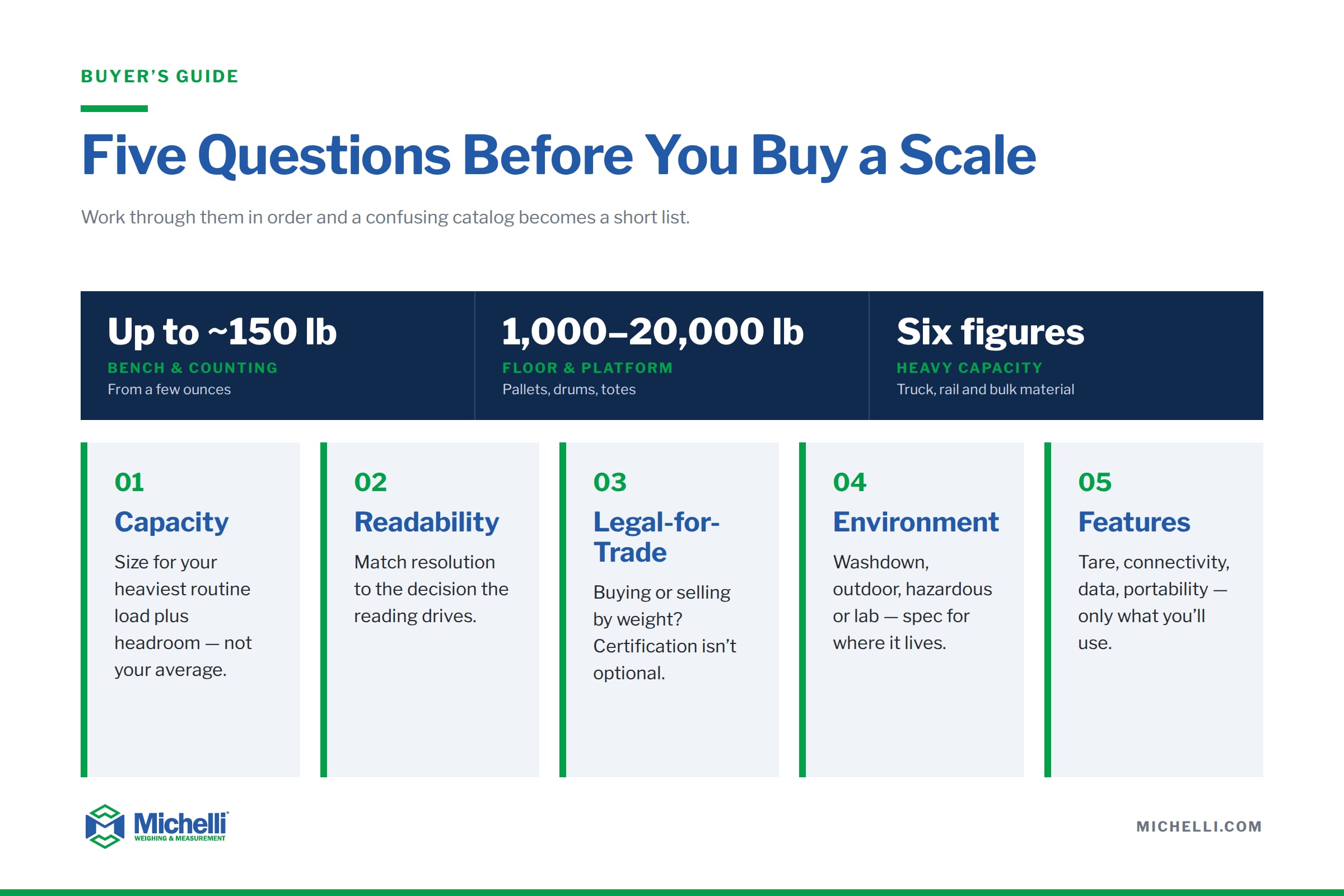
1. Start With Capacity — and Leave Headroom
Capacity is the maximum weight a scale can measure accurately. Exceed it and you get bad readings at best, permanent load cell damage at worst.
Size for your heaviest routine load plus meaningful headroom, not for your average. A shipping operation whose typical parcel is 40 lb but occasionally handles 300 lb pallets needs to be sized for the pallets. Roughly: bench and counting scales cover a few ounces to about 150 lb; floor and platform scales handle 1,000 to 20,000 lb; medium-capacity scales cover the middle of that range; and heavy-capacity scales for truck, rail, and bulk material run well into six figures.
2. Match Readability to What the Measurement Decides
Readability is the smallest increment a scale displays, and more is not automatically better — higher resolution costs more and makes a scale more sensitive to vibration and air movement.
Ask what decision the reading drives. Weighing raw material into a mixer where the tolerance is a pound, resolution finer than that buys nothing. Formulating a compound where a fraction of a gram changes the outcome, you need an analytical balance and the environmental controls that go with it. Our precision measurement devices cover that end of the range.
3. Determine Whether You Need Legal-for-Trade
This one is not a preference. If you buy or sell by weight — produce at a checkout, scrap at a yard, aggregate at a loadout — the scale must be legal-for-trade certified and verified on a schedule.
Legal-for-trade equipment is built and sealed to meet NIST Handbook 44 requirements, and it carries ongoing obligations for inspections and certifications. Buying a non-certified scale for a commerce application is the most costly version of this mistake, because the fix is replacement rather than adjustment.
4. Specify for the Environment, Not the Spec Sheet
Where the scale lives determines how long it stays accurate. Washdown and food processing call for stainless construction and a suitable IP rating. Outdoor and yard use needs sealed enclosures rated for temperature swings, moisture, and dust. Hazardous locations require intrinsically safe equipment rated for the classified area. Labs need draft shields and stable surfaces, because air movement and vibration matter at high resolution.
Getting this wrong is the most common reason a scale that met spec on paper drifts out of tolerance within a year — see How Extreme Environments Impact Scale Accuracy.
5. Decide Which Features Actually Earn Their Cost
Modern indicators offer far more than a display. Worth paying for when they match your workflow:
Tare for any application weighing product in a container
Connectivity when weight data needs to reach an ERP, POS, or ticketing system rather than a clipboard
Data recording where you need traceability for audits or quality records
Battery operation and portability for field, yard, or multi-station use
Features you do not use still add cost and, occasionally, failure points.
Finally, factor in what happens after the sale. Confirm the equipment can be serviced where you operate, and include calibration, installation, and preventative maintenance in the total cost. A cheaper scale that no local technician stocks parts for is not cheaper.
If the need is temporary — a project, a seasonal peak, or a trial before committing — rental scales and equipment are worth considering before a purchase.
Michelli: Your Precision Partner
With over 75 years of experience and 50+ locations across 18 states, Michelli Weighing & Measurement helps businesses specify equipment that fits the application the first time — then keeps it accurate. Browse our products and the manufacturers we represent, or use our inaccuracy cost calculator to see what your current equipment may be costing you.
Not sure where to start? Contact us and we will help you match the equipment to the job.
