
When it comes to force and weight measurement, two terms come up regularly: load cells and strain gauges. They are closely connected, but they are not the same thing. Understanding the difference is key to choosing the right measurement solution for your application.
In this guide, we break down what load cells and strain gauges are, how they work, where each is used, and how to decide which one makes sense for your application.
What Is a Strain Gauge?
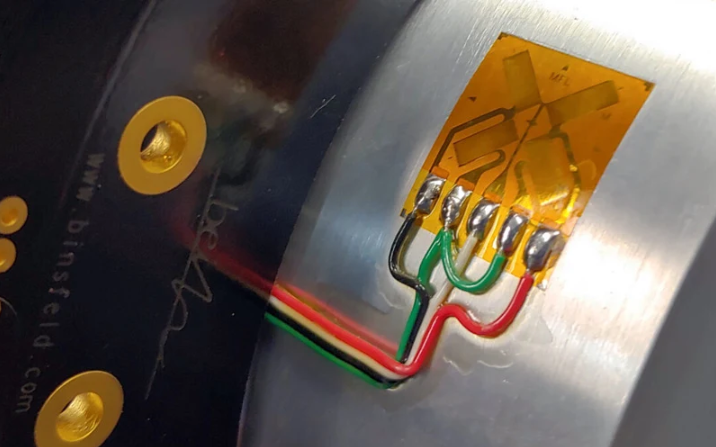
A strain gauge is a sensor used to measure strain, which is the amount of deformation a material experiences when a force is applied. A strain gauge is typically made of thin metallic foil or wire, arranged in a grid pattern, and bonded directly to the surface being measured.
When the material stretches or compresses, the strain gauge deforms along with it. This deformation causes a change in electrical resistance, which the strain gauge measures and translates into strain data.
Key Features of Strain Gauges
- Measures very small levels of strain or deformation
- Bonded directly to a structure or component
- Outputs a raw signal that must be conditioned
- Highly sensitive and customizable for specific test setups
Common Strain Gauge Applications
- Structural testing in aerospace and civil engineering
- Research and development environments
- Stress and fatigue analysis
- Embedded monitoring in mechanical systems
Strain gauges are ideal when you need insight into how a material behaves under load rather than simply measuring the force itself.
What Is a Load Cell?
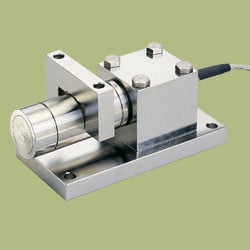
A load cell is a complete force measurement device that converts mechanical force into an electrical signal. Most modern load cells use strain gauges internally, but the key difference is that a load cell is a fully engineered, calibrated, and enclosed system designed specifically to measure force or weight accurately and repeatedly. Unlike the strain gauge, it is not bonded directly to the surface being measured.
- Single-Point Load Cells
Single point load cells are made to measure weight applied at a single, specific point—making them perfect for platform scales, retail scales, and small hopper weighing. These load cells are ideal for packaging, food processing, and logistics, where precise measurement is essential. - S-Type Load Cells
This load cell gets its name from its design. It’s a versatile load cell that can measure both tension (pulling) and compression (pushing) forces. Inside, strain gauges detect the strain on the “S” beam when a load is applied, converting it into an electrical signal. They’re compact, robust, and suitable for many industrial and laboratory settings. - Bending Beam / Shear Beam Load Cell
Bending and shear beam load cells are compact, precise, and durable solutions for medium-to-heavy weighing tasks. These types of load cells are especially useful in applications where multiple load cells work together to support a structure, like a platform, hopper system or tank system. - Double-Ended Shear Beam
Double-ended shear beam load cells are robust, high-capacity sensors ideal for demanding applications like truck scales and tank scales. Their symmetrical, dual-support design offers superior stability, accuracy, and resistance to harsh loading conditions. - Canister Load Cell
Canister load cells are heavy-duty compression load cells built to handle extreme loads in rugged environments. Their robust design and high capacity make them the standard type of load cell utilized in vehicle scales, silos, and industrial weighing systems.

Key Features of Load Cells
- Outputs a standardized electrical signal
- Factory calibrated for accuracy and repeatability
- Built for durability in industrial environments
- Easily integrated with indicators, PLCs, and control systems
Common Load Cell Applications
- Industrial scales and weighing systems
- Material testing machines
- Manufacturing and process control
- Crane, hoist, and overload monitoring
Load cells are purpose-built for reliable, real-world force and weight measurement.
Load Cell vs. Strain Gauge: Key Differences
| Feature | Strain Gauge | Load Cell |
| Primary Function | Measures strain or deformation | Measures force or weight |
| Form Factor | Small, bonded to structures | Encased, self-contained device |
| Output Signal | Raw resistance change | Standardized electrical signal |
| Typical Use | Research, testing, stress analysis | Industrial and commercial weighing |
| Integration | Requires signal conditioning | Ready for instrumentation use |
Which One Do You Need?
The right choice depends on your application and measurement goals.
Choose a STRAIN GAUGE if:
- You are performing stress or fatigue analysis
- You need to monitor deformation on a custom component
- You are developing or testing a new product
- You need highly localized strain data
Choose a LOAD CELL if:
- You need accurate, repeatable force or weight measurement
- Your application is industrial or production-based
- You want a calibrated, ready-to-use solution
- You need easy integration with control systems or indicators
Either Way, Choose Michelli—Your Full Stack Measurement Partner
Strain gauges and load cells are built on the same fundamental sensing technology, but they are engineered for different measurement objectives. Strain gauges provide detailed insight into material strain and stress at a component level, while load cells integrate that technology into a calibrated, repeatable, and application-ready solution for force and weight measurement in the field. Knowing the difference helps ensure you select the right approach for your environment, accuracy requirements, and long-term reliability needs.
If you are evaluating measurement options or refining an existing system, our metrology experts can help you determine the best solution for your application. Contact us to discuss your force or weight measurement requirements, or request calibration or service support to ensure your equipment continues to perform to specification.
Looking for reliable force or weight measurement solutions?
Michelli provides expert support for load cells and strain gauges, including calibration services that meet industry and regulatory standards.